Southern Ports
Charting one course for three regional ports

Three ports, one organisation
Southern Ports Authority is a Government Trading Enterprise operating Western Australia's three southern regional ports at Albany, Bunbury and Esperance, with a remit that reaches well beyond the wharf into regional development, environmental custodianship and community partnership.
Their old website could only take them so far. Structured port by port rather than around the organisation as a whole, it offered limited support for telling one connected story. Navigation was hard to maintain, the CMS was constrained, and critical operational content sat in PDFs that were hard to find and harder to use. With a refreshed brand launching in parallel, Southern Ports engaged equ to rebuild the platform from the ground up.

A brief that asked to be challenged
Southern Ports Authority did not want a like-for-like rebuild. The team said plainly that they wanted to be challenged, and our response went beyond the scope with an “art of the possible” program covering audience pathways, live operational data and immersive port storytelling.
Discovery turned that ambition into a plan. We agreed goals and success measures, defined personas, audited analytics, search behaviour and content performance, and reviewed leading port authorities here and overseas. The findings became a new sitemap and a specifications document defining every template, module and component before a line of code was written.
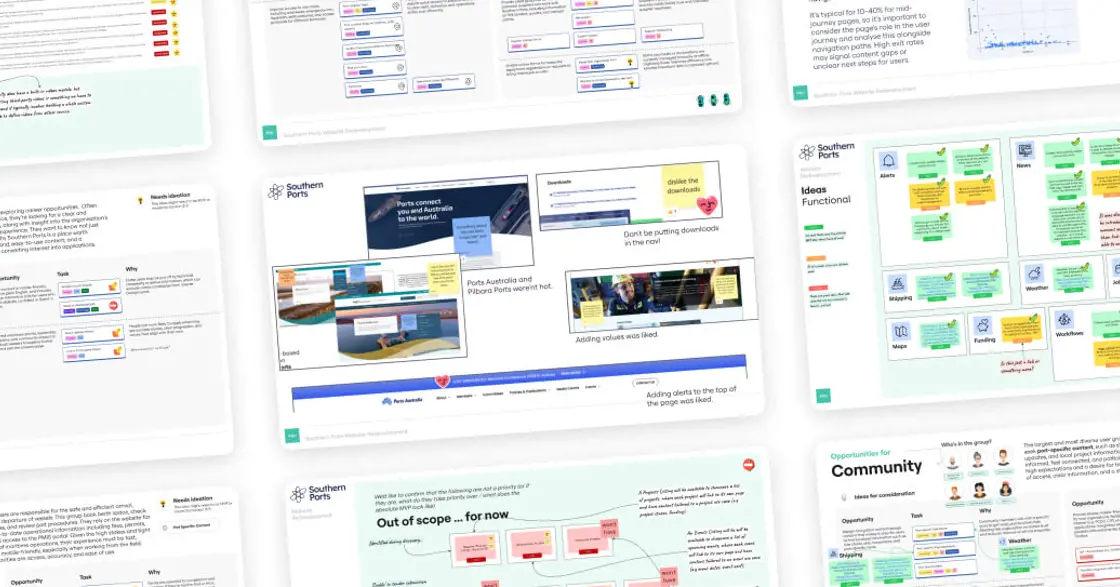



Testing a prototype costs hours. Testing a live website costs weeks. We chose hours
An architecture built around four audiences
A port website serves people with very different jobs to do. Port users want shipping schedules, berth information and trade data. Contractors need inductions, site access and safety requirements. Community members and job seekers look for news, careers and environment content. Government, regulators and investors want governance documents and performance data.
We structured the site around these pathways, then put interactive prototypes in front of real users to test the navigation, labelling and the usability of the map. Testing confirmed where the design worked and, more usefully, where it did not, while issues were still easy to fix.

Co-designed, not presented
Rather than deliver designs for review, we ran collaborative workshops with the Southern Ports team to sketch, challenge and refine concepts together. Their operational knowledge, from berth allocation to marine notices, shaped decisions we could not have made alone.
Delivery ran on a hybrid agile model of fortnightly sprints, show and tells and a shared backlog, with technical workshops bringing both IT teams together to agree architecture, integrations and security.


To ensure data security and user privacy, row-level security measures were implemented at the database level, preventing unauthorised access to sensitive information.
Where the sea meets the land
Southern Ports' corporate style system was built for print and needed work to perform online. We extended it into a digital design system, defining type scales, colour contrast, component states and responsive behaviour that meet WCAG 2.2 AA while keeping the brand intact.
At its heart are the sea and topographical textures drawn from the brand, evoking bathymetric charts, coastline and the terrain of the south west. Used as backgrounds, dividers and overlays, they bring three geographically distinct ports under one visual language.
Three ports, one map
The centrepiece of the site is an interactive map that lets users explore Albany, Bunbury and Esperance in a single environment. Built on geospatial data maintained by Southern Ports' own GIS team, it shows berths, buildings, anchorages and port boundaries, so users can navigate the facilities and understand how each port is laid out. Information that was previously spread across static plans and PDF documents is now one explorable view of the organisation's assets.
A brief that asked to be challenged
The map is more than a plan. Vessel status flows through from the same port management system that drives the shipping schedule, so agents, operators and stakeholders can see which vessels are at berth, at anchor or recently departed. For the community, it turns an industrial site into something they can actually read.

Real-time shipping, straight from the source
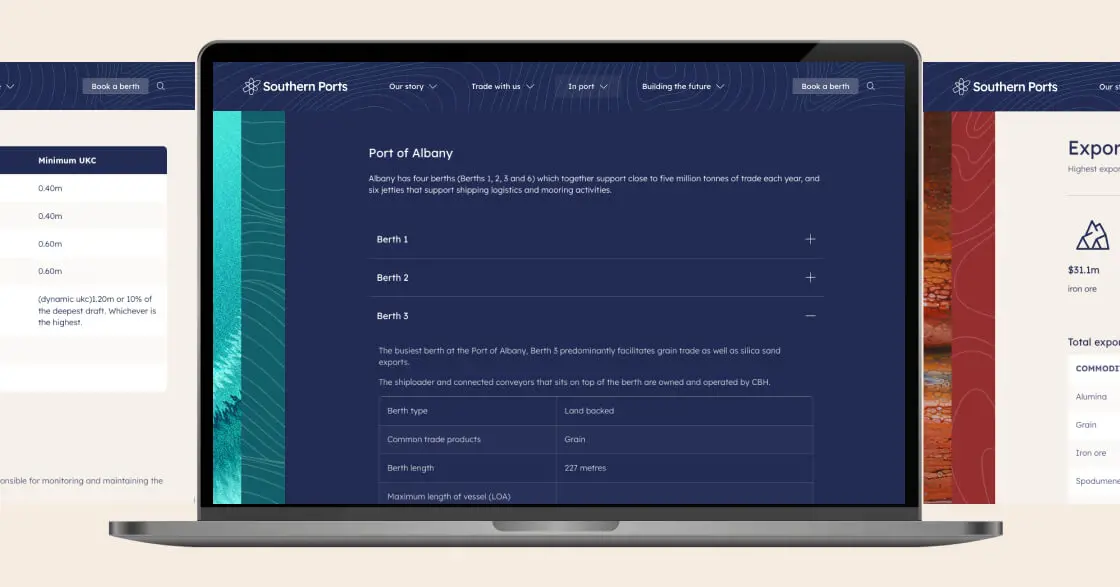
Shipping information comes directly from the port management system running Albany, Bunbury and Esperance. We built an integration that draws vessel data into the website in real-time, covering the fortnight past and the fortnight ahead, with each vessel's status shown as at berth, at anchor or departed. Information that once required a separate system or a document upload now sits on the website itself.
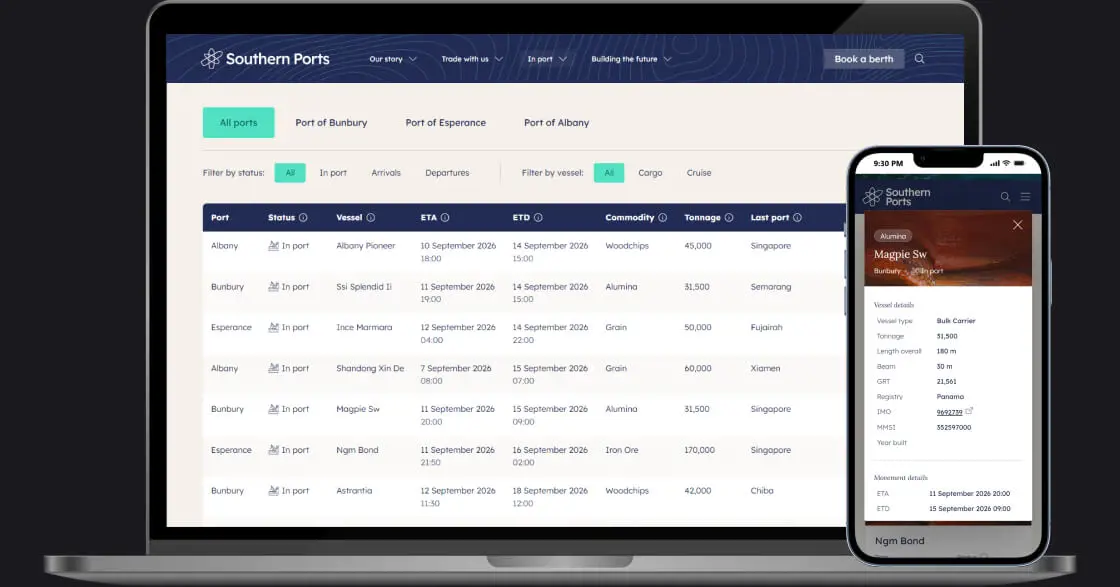
Connecting the website directly to the port management system removed a manual step and, more importantly, removed the delay. What the port knows, the website knows
Weather that shapes the working day.
Weather has an enormous influence on shipping across the three regions. Readings from around 15 beacons across the three ports feed wind, swell, tide and current data into the site every 10 to 15 minutes, alongside charts covering roughly seven days of recorded and forecast conditions. Data that once sent users to third-party sources now sits beside the berth and vessel information it relates to.

Big numbers, made bite-sized
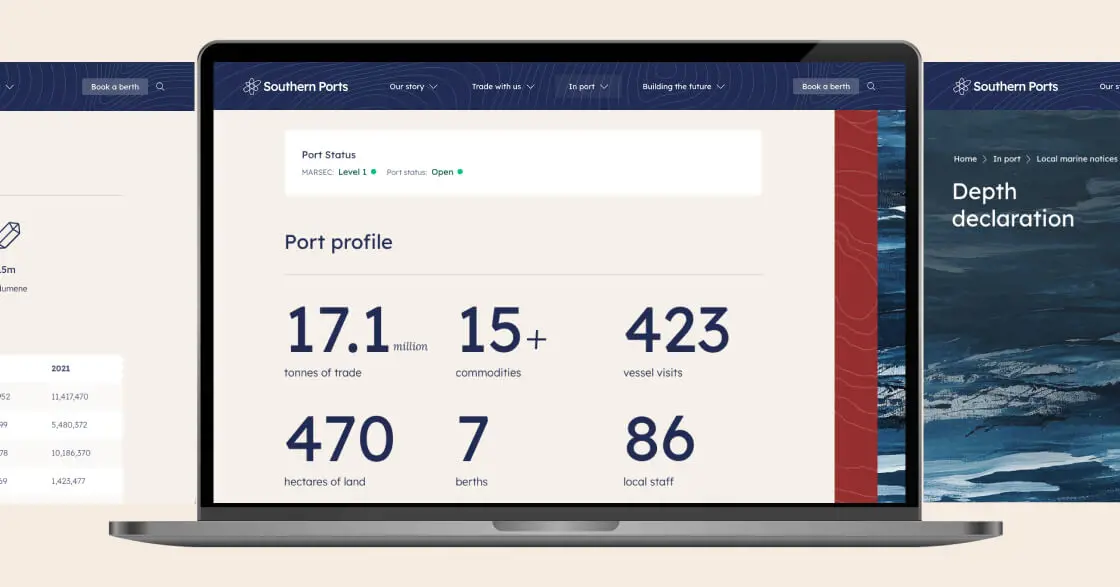
Southern Ports' scale is difficult to grasp in prose. Trade tonnage, vessel visits, berths, land holdings, commodities, employment and community investment are presented as statistics and infographics at both organisation and individual port level. Each figure is a CMS-managed component, so the Corporate Affairs team can keep the story current as the numbers change.
News for the regions, notices for the water.
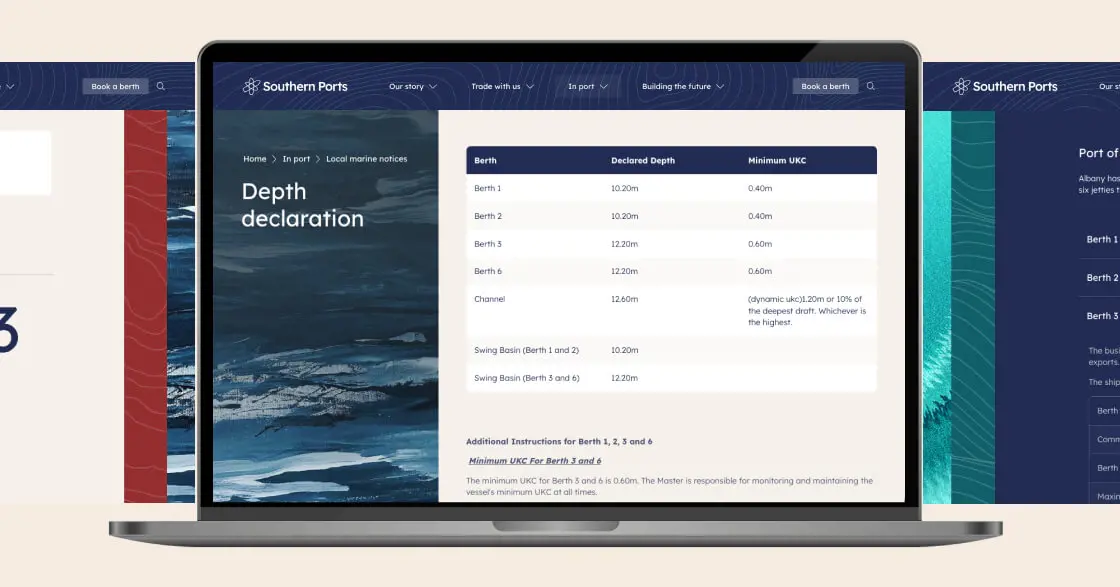
Alongside port and community news, the site publishes local marine notices for vessels and operators working within port waters. Both run through a four-role publishing workflow, from document uploaders through to administrators, with two-step approval configurable by content type and site section. Time-critical information can be issued quickly while corporate communications follow their normal approval path.

Enterprise ready on Sitefinity and AWS
We recommended and implemented Progress Sitefinity DXP for its editorial usability, governance controls and integration with the Microsoft stack. equ is Australia's most experienced Sitefinity implementation partner and the only certified Premier Partner in Western Australia.
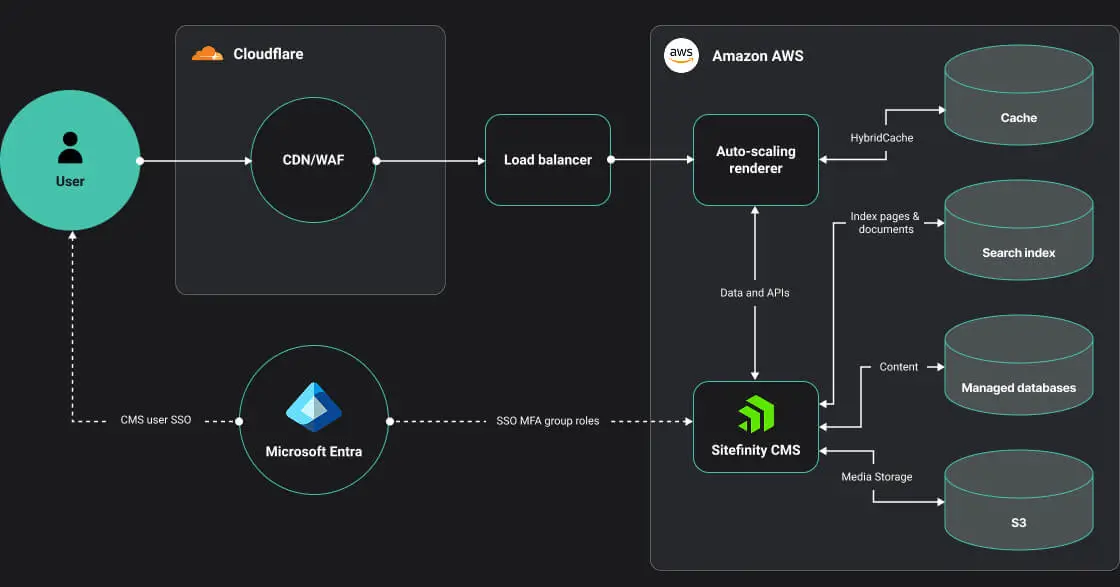
The platform runs on AWS in Sydney, with an auto-scaling renderer, managed databases, caching and a search index that covers PDF content as well as pages. Cloudflare handles CDN delivery and web application firewall protection across both domains, and CMS access is authenticated through Microsoft Entra single sign-on, with multi-factor authentication and roles mapped automatically from Entra groups.
One organisation, one digital front door
The new website brings Albany, Bunbury and Esperance together under a single brand and a single structure, pairing the storytelling of a modern corporate site with the live operational data of a working port. Port users reach the information their day depends on faster, the community gets a clearer view of what the ports contribute, and the Corporate Affairs team, trained before launch, runs the platform themselves.



Next case study